
Sairam Krishnan
Research

Research

Drone-Megaddon

A Real-Time Strategy Interface for Managing Drone Swarms

Carnegie Mellon course project, 2014; archived on engrXiv, 2026

10.31224/6924
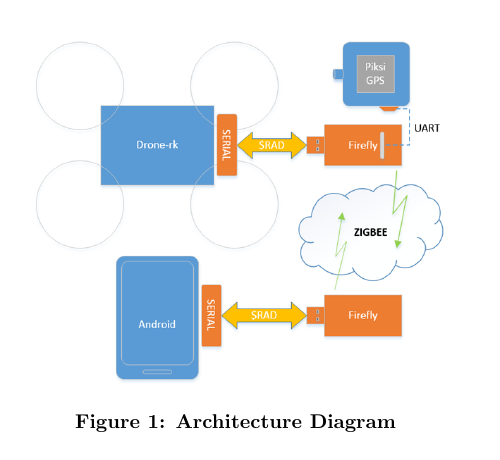
Architecture diagram showing the Android RTS interface sending $RAD commands over serial and ZigBee through Firefly nodes to Drone-RK, with Piksi GPS connected by UART.
Command a drone swarm like StarCraft

I co-built an end-to-end Android, radio, and embedded-control prototype that translated real-time strategy interactions into drone commands.

The 2014 work established the command interface and execution path; Drone-Megaddon 2026 extends that foundation with a proposed language-and-vision architecture for operator-supervised coordination.

Built an end-to-end Android, Zigbee radio, and embedded-control prototype using a real-time strategy interface.
Drone-Megaddon 2026

Co-Intelligent Swarm Control with Language and Vision Models

engrXiv preprint, 2026; proposal, not a deployed-system evaluation

10.31224/6987
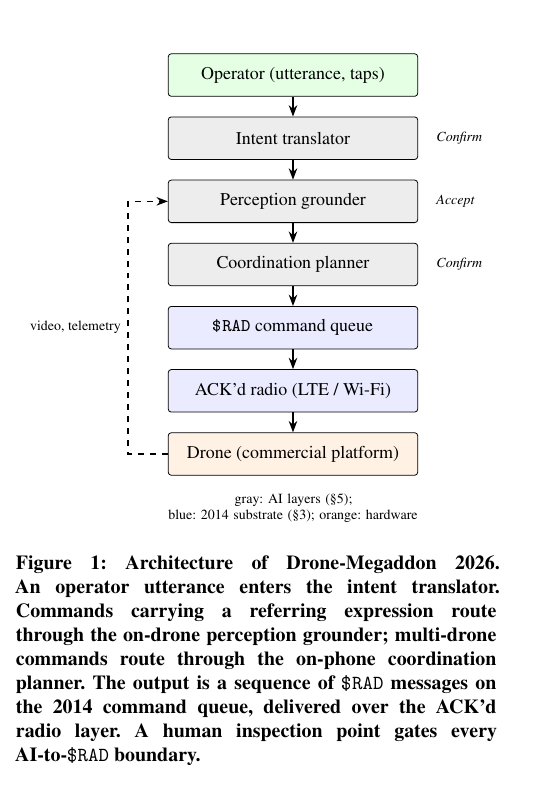
An operator utterance enters the intent translator. Referring expressions route through the perception grounder, while multi-drone commands route through the coordination planner. The resulting $RAD messages enter the 2014 command queue, cross the ACK’d radio layer, and reach the drone commercial platform. Human inspection gates every AI-to-$RAD boundary.
Speak to the swarm, approve each command

I coauthored a proposed extension of our built 2014 drone-control prototype: translate operator language into checked commands, ground references in video and track targets, then coordinate assignments across drones.

The architecture places language and vision models inside an operator-supervised system, with explicit choices about edge versus cloud execution, latency, bandwidth, and degraded connectivity.

An illustrative search-and-rescue trace shows how the layers work together; the paper reports no quantitative results from a deployed 2026 system.

Proposes language-intent, visual-grounding, and multi-drone coordination layers with operator inspection gates, audit logs, and manual-control fallback under degraded connectivity.

Illustrated through a search-and-rescue scenario.

Who Trains the Next Senior?

Managing Software Engineering When AI Makes Code Cheap

SSRN working paper, 2026

10.2139/ssrn.7083078
AI makes code abundant
verification and judgment remain scarce

Four management moves

Smaller reviewable units
Scrutiny matched to consequence
Evidence-backed gates
Outcome-based metrics
Code is cheap; verifying it is not

I coauthored a framework for leading engineering organizations when AI makes code abundant but verification and judgment remain scarce.

It connects review theater, engineer development, and team incentives to practical changes: smaller reviewable units, scrutiny matched to consequence, evidence-backed gates, and outcome-based metrics.

An exploratory, correlational analysis of several thousand commits from a single organization illustrates why raw activity can overstate progress; the paper turns those observations into testable propositions about verification and apprenticeship.

Examines "review theater": approvals that no longer meaningfully verify AI-generated work.

Proposes smaller reviewable changes, scrutiny matched to consequence, deliberate apprenticeship, and measurement of verified outcomes rather than code volume.

The analysis is correlational rather than causal.

A Multi-Layer Framework for Evaluating the Return on Investment of AI Projects

SSRN working paper, 2026; Wharton independent study

10.2139/ssrn.6732598
  1. SCALE strategic readiness assessment
  2. ROIC decomposition through a value driver tree
  3. stage-gate phased investment
  4. synthesized decision scorecard
Which AI projects to fund, and when

I coauthored a decision framework connecting AI strategy to investment and execution: assess organizational readiness, trace business value through ROIC, phase investment through evidence-based gates, and synthesize a decision scorecard.

An eight-category risk assessment makes inference economics, vendor dependency, and organizational friction explicit.

Eight illustrative public-company cases, from Salesforce and Spotify to JPMorgan and NatWest, show how the framework changes investment conditions across deployment types; this is illustrative validation, not empirical validation.

The work was a Wharton independent study sponsored by Professor Gad Allon.

Integrates readiness, ROIC value drivers, staged investment, and a decision scorecard with eight categories of AI risk, including vendor dependency and organizational friction.

Eight illustrative public-company cases examine inference costs and organizational readiness.

Wharton independent study; faculty sponsor Professor Gad Allon.