Cite the File and Page for Every Number
An all-staff session on checking an AI answer before you send it, taught from real failure cases, with a record that the training happened.
Delivered for Sonova.
 Sairam Krishnan
An all-staff session on checking an AI answer before you send it, taught from real failure cases, with a record that the training happened.
Delivered for Sonova.
One principle at four levels, from a production correction loop to a finance team's skill that writes 'Needs explanation' instead of inventing a reason.
How a knowledge graph enriches a question before the model sees it and checks the answer afterward, and when a small model on your own laptop is the better tool.
Delivered for Atos.
When a graph beats plain vector retrieval, and how to prove it with a loop that checks each generated claim against canonical facts and feeds the errors back.
An executive briefing on grounding AI in records you trust: fresh data, resolved identities, human corrections that persist, and a graph someone keeps current.
Use a narrow model call to pull out the facts, compute the score in code, and withhold generated feedback that cannot point to its evidence.
Freeze human-labeled cases, compare judges blind, and separate model failures from truncation before you switch to the cheaper model.
A case study of a provenance-aware graph behind generated audio tours, where a line that is not true for the place is dropped rather than spoken.
How to run supervised entity resolution and ML-generated metadata so that human corrections persist when the model is retrained.
Turn AI skeptics into champions by taking their concerns seriously and showing how AI extends their expertise.
Delivered for Morgan Lewis.
How these tools work in plain words, which one to pick, and how to prompt so the model shows its work.
Delivered for Jacobson Strategic and HP.
A keynote for mission-driven leaders on using AI to win back staff time and reach more people, safely.
Delivered for Philadelphia Eagles.
A two-part course that takes a team from prompting to a reusable skill they have tested against formulas, edge cases and invented explanations.
Delivered for Sonova.
A funder-sponsored cohort for nonprofit teams: an AI use policy, one automated workflow per team, and the habit of checking answers.
For trainers and faculty: design AI exercises where learners catch a planted error, from a flawed web app in 2013 to a budget skill that invents reasons in 2026.
Delivered for Carnegie Mellon and Sonova.
For law and professional-services firms: sort everyday tasks into safe, check first, and off limits, and give champions a kit that keeps the guide current.
Delivered for Morgan Lewis.
Define success before choosing technology, then decide with evidence which pilots to expand, redesign or stop.
A working session on the buyer's own pilots: score each against three stage gates and eight risk categories, and leave with an expand, redesign or stop call for each.
A case session that runs Salesforce Agentforce, Spotify, Shopify Magic, JPMorgan COiN and their comparison cases through one framework, so a class sees why similar bets get different verdicts.
Price AI risk into the discount rate, including inference cost scaling and vendor dependency, and see why build versus buy trades one risk for another.
A hands-on session for working teams on retrieval, workflows versus agents, and reusable skills, ending with a checklist for when an agent is worth building.
Delivered for HP, Morgan Lewis and Sonova.
A sequence leaders can audit: governance first, then deterministic steps, then simple agents only where the automations need coordinating.
Delivered for PBS.
Engineering controls translated for risk owners: scoped tool permissions, action checks, audit logs, autonomy limits, and evals kept as audit evidence.
Make agent-built code verifiable: a test the builder never sees, written and reviewed by a different model family, and mutation checks that prove the test guards the fix.
Team operating standards for coding agents: design review, CI gates and acceptance rules every agent change must pass, taught from a framework other teams adopted.
Hash-bound release gates for agent pipelines, so a model can draft and revise but cannot change an accepted fact without failing the release.
How to build multiagent simulations where each agent holds its line, and score the outcome with arithmetic rather than a model's opinion.
For broker-dealers and wealth firms: apply real-time surveillance thinking to AI agents, tracking each action and limiting system access as FINRA's 2026 report suggests.
A live-demo talk on systems that act for people: start disarmed, drop stale input, recheck the target, and keep a human able to stop it, from a 2014 drone swarm to a 2026 gesture app.
Capture incidents as trigger, fault, symptom and fix, keep that graph current, and let your own and your clients' agents query it.
Delivered for Atos.
When AI drafts the code juniors used to learn from, apprenticeship has to be rebuilt on purpose; leave with four management moves and the measures that survive.
How management systems change when software production becomes abundant.
A working session for managers on ending review theater: smaller changes, scrutiny matched to consequence, and metrics that count verified outcomes instead of commits.
Why technical decisions only matter when teams can carry them into the organization.
How I coached half my team of eight to promotion and a senior engineer into independent ownership, and what that takes when juniors work beside agents.
How a Spark batch pipeline became Flink, Kafka and Cassandra streaming for millions of tracks, and why grounded AI depends on data that fresh.
Two separate Alexa results: an orchestration layer that saved $40M a year by removing redundant processing, and a 40% gain in recognition and routing accuracy from feeding context back.
Self-service deployment and peak-event capacity planning: what cut weekly operational issues from 40 to 10 and peak registration issues tenfold.
An executive briefing for law firms: where the work loses time, why generic AI fails there, three deployments that pay off first, and a 60-day plan.
Delivered for Morgan Lewis.
An executive briefing for nonprofits: where the work loses time, why generic AI fails there, three deployments that pay off first, and a 60-day plan.
Delivered for Philadelphia Eagles.
An executive briefing for public media: where the work loses time, why generic AI fails there, three deployments that pay off first, and a 60-day plan.
Delivered for PBS.
An executive briefing for healthcare teams: where the work loses time, why generic AI fails there, three deployments that pay off first, and a 60-day plan.
Delivered for Sonova.
An executive briefing for IT organizations: where the work loses time, why generic AI fails there, three deployments that pay off first, and a 60-day plan.
Delivered for HP and Atos.
An executive briefing for communications teams: where the work loses time, why generic AI fails there, three deployments that pay off first, and a 60-day plan.
Delivered for Jacobson Strategic.
An executive briefing for media companies: where the work loses time, why generic AI fails there, three deployments that pay off first, and a 60-day plan.
An executive briefing for financial firms: where the work loses time, why generic AI fails there, three deployments that pay off first, and a 60-day plan.
Not listed? Tell me what your people need
Own AI curriculum strategy and development as Praxtera’s principal AI subject-matter expert and lead speaker, translating production AI/ML leadership and original Wharton research into programs for HP, Morgan Lewis, PBS, and Sonova.
Designed Praxtera’s executive AI curriculum, built on original Wharton research to help executives evaluate, govern, and deploy AI.
Lead client discovery, technical advisory sessions, and office hours; design AI solution architectures for contractor implementation and help teams decide what to automate and when agent coordination is warranted.
Basics to Advanced Automation
Mar 18, 2026
300+ community and business leaders
Eagles Care Summit archivePhiladelphia Eagles postMichelle Histand’s post
I showed nonprofit leaders how to put AI to work for their missions, starting with the basics of models and prompts and building up to Claude skills, agents and retrieval over their own documents.
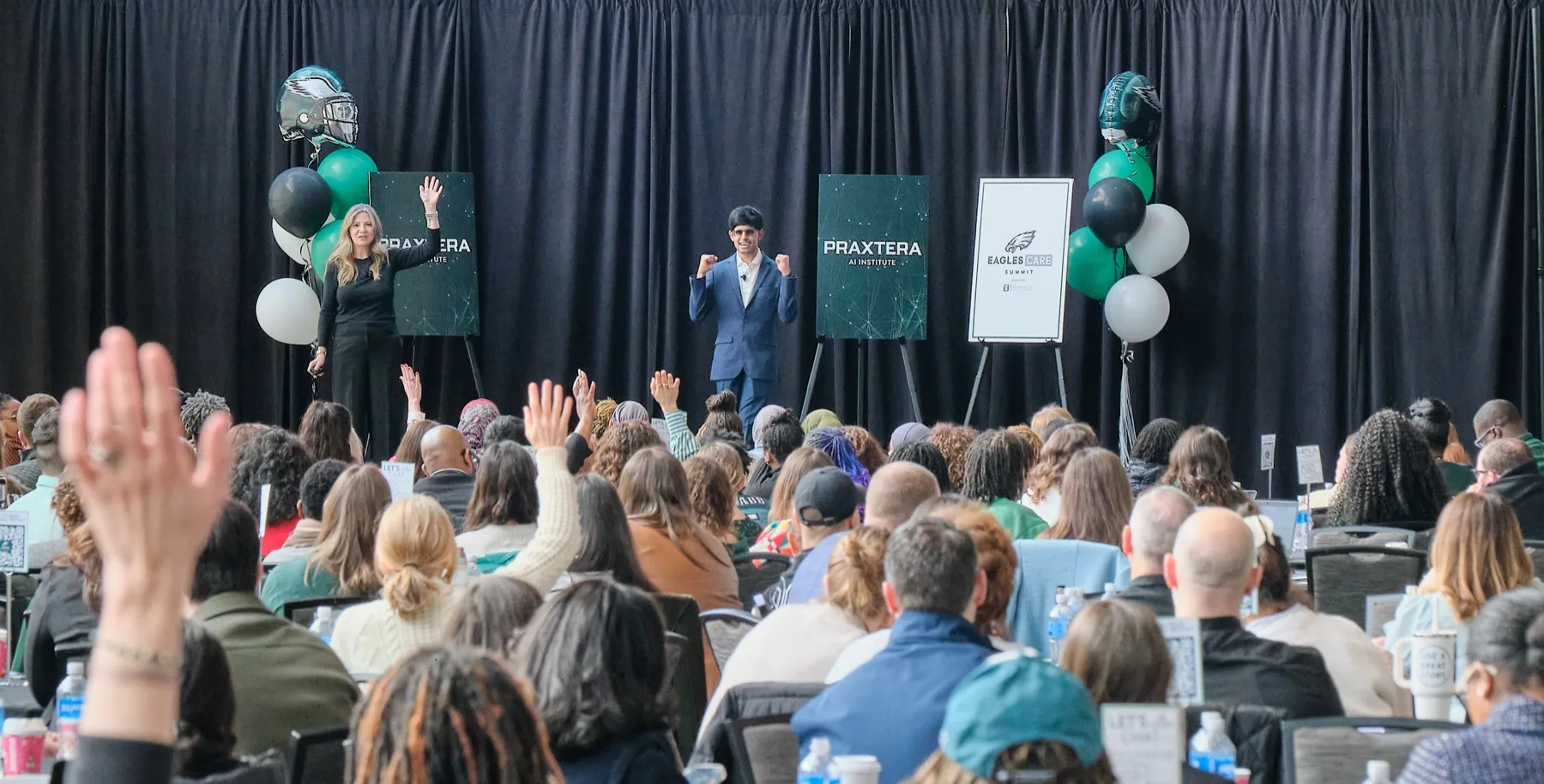
Keynoted the Philadelphia Eagles' 12th annual Eagles Care Summit on March 18, 2026, delivering "AI for Impact" to more than 300 community and business leaders.
The summit is the team’s yearly gathering of Philadelphia’s nonprofit community, and this year’s room came from more than 150 local nonprofits. Praxtera’s live two-hour session was built around AI they could use right away.
From Praxtera’s AI Basics - Prompting course, with the higher-level concepts of its AI Agents - RAG, Workflows, Skills, and More course.
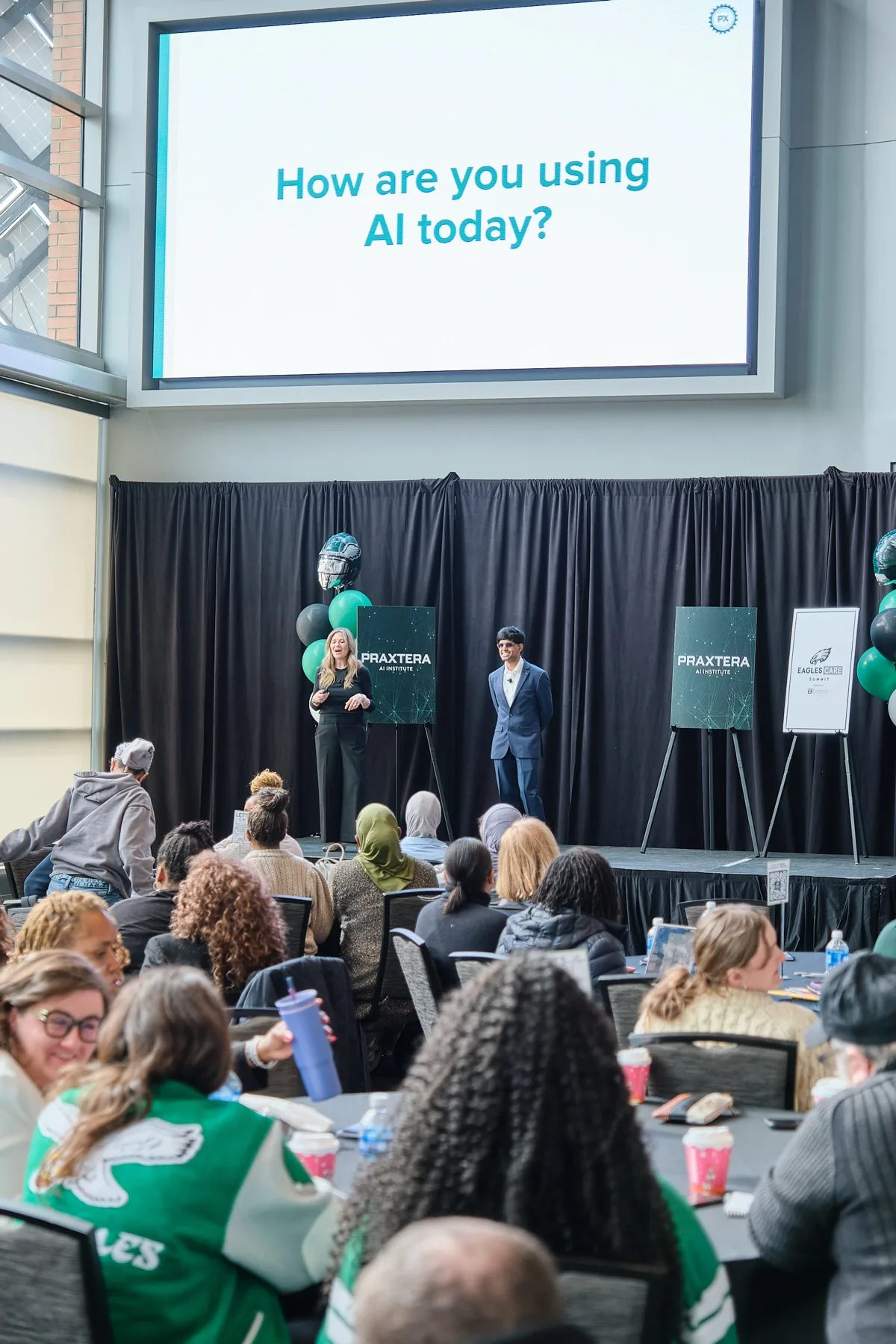
The session opened on one question for the room, “How are you using AI today?” Attendees traded what they already use it for and their time-saving shortcuts.
A model is like a student made to read most of the internet: it learns patterns without understanding them and predicts one word at a time. That is why it can miss nuance or invent facts.
Most work needs one generalist, such as ChatGPT, Gemini or Copilot. Know when to call a specialist: Perplexity when an answer needs citations, Claude for very long reports, Copilot inside Word, Excel and Outlook, NotebookLM for your own files.
A prompt works like a brief to a very literal assistant. H4W covers who you are, what you need, why, who it is for and how it should look; COSTAR adds context, objective, style, tone, audience and response.
Then where AI fits in a working day: a long report turned into a few key points, a hard email started from a first draft instead of a blank page, and messy meeting notes turned into action items.
Claude skills were still very new. A skill saves the instructions for one kind of task so Claude can reuse them, the same idea as a custom GPT in ChatGPT, an agent in Copilot or a Gem in Gemini.
How the pieces differ: a skill holds the know-how for a task, an MCP server connects the model to outside tools and data, and a plugin packages these to install in one step.
A workflow runs the same steps every time; an agent works toward a goal and chooses its own steps, including which workflow to call.
Retrieval-augmented generation lets the model look things up in an organization’s documents first. It finds the passages that matter, adds them to the prompt and answers from them, so its answers rest on that organization’s information.
Praxtera doesn’t just teach AI, they make it usable. More than 300 leaders walked away not just understanding AI, but actively applying it in their daily work. That’s the difference between exposure and real adoption.
Tina D’Orazio, Chief of Staff, Philadelphia Eagles
I was the AI subject-matter expert, co-keynoting with Michelle Histand, a communications strategist.
Taught Jacobson Strategic’s team to prompt AI tools well.
This was the first run of the Praxtera curriculum: Jacobson Strategic is the crisis-communications firm led by Praxtera’s founders.
Why structure and context change what a model writes. The team rewrote vague prompts with the 5 W’s + How and COSTAR frameworks, and wrote image prompts with VISUAL.
Then one piece of bad news, a delayed software rollout, went to four audiences: a colleague, the CEO, customers and an all-hands. Same facts, four messages.
Everyday patterns followed: a 15-message email thread summarized into decisions, owners and deadlines; a budget request built on AIDA; and one board summary drawn from five department reports.
ChatGPT, Gemini, Claude, Perplexity, Microsoft Copilot and NotebookLM side by side. One generalist covers most work; each also has a specialty, such as Perplexity for cited research, Claude for long documents and Copilot inside Microsoft 365.
How models learn patterns from examples, and why that makes them miss nuance, amplify bias and state made-up facts with confidence, shown with a live hallucination example. The rule: always verify, always edit.
Putting a model’s ability to adopt a persona and roleplay to work in the team’s day-to-day communications.
Sairam was the AI subject-matter expert, co-teaching with Michelle Histand, a communications strategist.
Oct to Nov 2025
I enabled HP teams to expand Copilot use into reusable workflows and skills for recurring tasks, with hands-on labs in requirements translation, rapid prototyping, and IT troubleshooting.
Praxtera’s first client program after the Jacobson pilot: two sessions for HP’s IT and digital-solutions teams, from how models work to building agents.
Oct 2025
Built on Praxtera’s AI Basics - Prompting course.
How large language models work and where they fail, from bias to hallucination; choosing among ChatGPT, Gemini, Claude, Copilot, Perplexity, and NotebookLM; the H4W and COSTAR prompt frameworks; and AI across the software development lifecycle.
Participants rewrote one message for four audiences, built a slide deck from three reports, and generated a clickable prototype in Gemini.
Model choice was taught on their own jobs: ChatGPT, Claude and Perplexity for a delivery manager’s AI return-on-investment report to leadership, and ChatGPT, Gemini and Perplexity for architects designing a customer-service chatbot on Salesforce.
For each stage of that lifecycle, the team mapped what AI takes in and hands back: user stories from stakeholder interviews, architecture decision records, test suites built from negative scenarios, and rollout, canary and rollback plans.
Between sessions, each participant used AI to research where the IT industry is headed and wrote a one-page brief.
Nov 12, 2025
Taught at HP as Applying AI in IT and Digital Solutions, built on Praxtera’s AI Agents - RAG, Workflows, Skills, and More course.
Retrieval-augmented generation, vector databases, and knowledge graphs; custom GPTs; the difference between AI workflows and agents, and a checklist for when an agent is worth building; and AI governance.
Participants built a business-requirements translator and designed an IT troubleshooting agent.
Retrieval was shown on their own work: a store of sample business and functional requirements sits in front of the model, so it translates a new RFP from the team’s own documents.
A workflow follows fixed steps; an agent reasons and picks which workflows to run. The AGENT checklist: autonomous, goal-oriented, error-tolerant, necessary info, time saving. Strategic decisions, one-time tasks and judgment calls stay with people.
The troubleshooter followed a live agent build: it greets the user, identifies the issue, walks through fixes or hands off to a person, and confirms the resolution.
I was the AI/ML specialist and subject-matter expert, co-teaching the first session with Michelle Histand, a communications strategist, and the second with Lakshman Mantha, a software engineer who covered Microsoft Copilot.
I trained the firm’s internal trainers and champions to help initially resistant lawyers adopt AI, turning real objections into live roleplay and reusable enablement toolkits.
Morgan, Lewis & Bockius is a global law firm. The room was its internal AI trainers and champions. They already knew prompting basics, so the two sessions went straight to adoption and agents.
AI adoption and change-management workshop · Morgan Lewis
The innovation adoption curve, Deloitte Business Chemistry, and the MAPPR model for diagnosing resistance: Motivation, Ability, Permission, Proof, and Reinforcement.
I added principles of persuasion from my Wharton Executive MBA, so champions could answer each objection, not just name it.
Participants listed why partners, associates, and staff would refuse AI.
Gemini sorted that board into ten resister personas, from the accuracy skeptic to the billable-hour traditionalist.
Each persona came with a name and a mindset, such as Verification Veronica, who fears phantom citations, and Billable Bill, for whom efficiency is a penalty under hourly billing.
In a live roleplay, Gemini played one persona while I used the CLEAR framework to win them over.
The live Gemini roleplay was my idea: the model plays the resister and a champion rehearses the answer. It later grew into Persuaider.
Groups then wrote persuasion messages for their own persona and designed a champion’s toolkit: a green, yellow, and red guide to which tasks are safe for AI, office hours, flash cards, and prompt-off competitions.
Built on Praxtera’s AI Agents - RAG, Workflows, Skills, and More course.
The agents course from HP, rebuilt for lawyers and not tied to any one vendor: retrieval grounded in the firm’s own documents, workflows versus agents, and the AGENT checklist for when an agent is worth building.
Each idea tied back to the first session: prototypes, demos and clear demonstrations that champions could use to show lawyers how AI simplifies their work and empowers them.
Praxtera’s train-the-trainer approach is a game changer for us. Our AI teams are even more equipped to teach it, scale it, and embed it across the firm. That’s what drives real adoption.
Colleen Nihill, Chief AI and Knowledge Officer, Morgan, Lewis & Bockius LLP
I was the AI subject-matter expert, co-teaching with Michelle Histand, a communications strategist.
AI strategy session · PBS
I taught a regional PBS station’s team how generative AI works, what has to be settled before anyone uses it, and how to turn work that pulls staff from the mission into workflows and simple agents.
The room was one regional PBS member station: newsroom, programming, membership and grant staff, working across TV, radio and Microsoft 365. Every example in the session was rebuilt around public media work.
What generative AI is and isn’t, how large language models work, and where they fail.
Generative AI, in three words: advanced Google search. Search is already a prediction engine, and a large language model is a far more powerful version of that prediction, one word at a time.
A custom GPT is an app running on the model as its operating system. Retrieval-augmented generation sits under the hood: it lays the organization’s own files over the model, so answers come from that material.
Tool choice came from a programming director’s real task: ChatGPT to turn ratings, streaming and social data into one performance story, Claude to mine viewer feedback for underserved audiences, and Perplexity to benchmark reach against other public media.
Privacy and governance frameworks as the first step, and how they set what AI can safely be used for.
Start with the pain points that take employees’ time away from work central to the mission.
Break each pain point into a list of steps.
Run those steps with a deterministic script, workflow, or skill.
A workflow runs predefined steps the same way every time. An agent reasons, plans and decides which workflows to use toward a goal.
When the automations need coordinating, add simple agents, and let the coordination grow more complex rather than the agents themselves.
Keep each agent simple enough to audit, and put the complexity in the relationships between agents.
Examples were set in the station’s work, in Copilot: a daily rundown drafted from recent email and the calendar, one script rewritten for radio, web, social and the member newsletter, and a grant narrative built from stored impact reports.
I led the AI content as subject-matter expert, alongside Michelle Histand, communications strategist and nonprofit leader.
Oct 21-22, 2026
I built a beginner-to-advanced progression from prompting to reusable workflows, inventory tracking, and prediction use cases. Participants tested budget-analysis software against live formulas, edge cases, and invented explanations, then turned corrections into reusable rules.
Sonova is a Swiss hearing-care company and the maker of Phonak hearing aids. This was a two-session program for its US operations and back-office teams, built around their answers to a pre-course survey.
Oct 21, 2026
Built on Praxtera’s AI Basics - Prompting course.
Generative AI explained plainly: a language model is not magic; it predicts the most likely answer from patterns it has learned. Most people can stick with one tool, such as Copilot, and call on a specialist for the rest.
Prompting practice used their own customers: a vague delay email for a clinic waiting on Phonak devices, rewritten using H4W and COSTAR, then a reply to a hearing care professional, refined until it was ready to send.
I ran the demo on Sonova’s own published reports: an outline for a briefing for new US employees, a performance section citing the file and page for every number, then a deck and an email to share it.
Then one Phonak EON paragraph, rewritten for a first-time hearing aid wearer, an audiologist and a worried adult daughter, with one check: did the model add any claim or number the source never made?
Oct 22, 2026
Built on Praxtera’s AI Agents - RAG, Workflows, Skills, and More course.
A Project is the room where files and instructions wait; a skill is a recipe you carry into any room. In a Project, Claude explained a repair center’s overtime from the notes; a chat with no files guessed.
Grounding works like an open-book exam: the model finds the passages that match, sets them beside the request, and answers from them. Hand it an outdated file and you get a confident, outdated answer.
Participants built one skill on September’s made-up budget-versus-actual export, then ran it on October’s with one line. Same model, same file: a plain chat guessed at causes, while the skill wrote “Needs explanation”.
The checks, in Excel: is each variance a formula, does the overtime flag hold when redone by hand, what happened to a freight line with no budget, and did the skill give any reason the file never did?
One fix went into the rules on the spot: mark a row with no budget as “No budget” instead of calculating a percent, then rebuild and rerun October.
Each person then built a skill for a task they repeat, from their survey answers: a KPI scorecard, WIP aging or a weekly Teams update, tested on made-up data until IT approves a tool.
I was the AI subject-matter expert, co-teaching both sessions with Michelle Histand, a communications strategist.
Web Applications Course Developer · Head Teaching Assistant
I helped rebuild Carnegie Mellon’s web application course, writing the demos, exercises and online platform that students learned from.
15-437/15-637 Web Application Development is a Carnegie Mellon computer science course for upper-level undergraduates and graduate students. I built the new materials in summer 2013 for the fall semester, which added Django alongside J2EE.
Redesigned the Web Applications course with the professor, planning a 20-lecture semester from client-side code and HTTP through relational and NoSQL databases, servlets, security, and Django, plus a follow-on Web Application Frameworks course.
Built the client-side exercise set: HTML5, CSS3, and JavaScript demos, from form validation and a calculator to single-player Pong and an image gallery, each with extension exercises.
Designed server-side exercises on sessions, cookies, and relational databases, an HTML-injection exercise on Django template escaping, and a deliberately flawed Django app for students to expose by writing tests.
Built reference survey apps in Spring MVC, Play, and Django, taking the Spring version through six releases on Google App Engine with image upload, AJAX editing, and survey recommendations.
Created a cloud platform for course administration.
Students logged in to view and try demos of each course concept; one set built up MVC step by step.
They also submitted assignments there, with guided walkthroughs such as building a survey app. It ran on Heroku first, then AWS.
In the second half of the semester, each team designed and built a web application of its own choosing, then demonstrated it to the course staff.
Instructed 105+ students as Agile Product Owner for their final projects.
I was the course developer and head teaching assistant, working with Professor Charlie Garrod, who taught the course.
Knowledge Graphs & Local Language Models
Presented how graphs enrich questions and check generated answers, how to choose model size, and how to set up a local model live.
Atos is a global, AI-powered technology partner. This was an independent talk, and each graph example ran twice: once for a hospital or a bank, once for IT operations.
Presented what a knowledge graph is, how it enriches questions before they reach a model, and how it checks the model’s answer afterward,
then where graphs go next: sub-graphs by topic, failure graphs, codified expertise, and the graph behind an API.
Covered small language models next: what they are, when to go small and when to go big, a live setup of a local model in five minutes, and how they change the way people work.
A node is a noun, an edge is a verb and a property is an adjective. Models draft the graph, people verify it, and only verified edges are the authority.
The same shape relabels in place, from a patient, her doctor and her drugs to a client, its payment service, the server it runs on, a change and an incident.
Before the model, the graph finds the facts that matter and a verified example of a good answer. Asked if a patient with a penicillin allergy can take amoxicillin, the model gave a safe no.
For a failing payment service, the same path led through its server to a library upgrade seventeen minutes before the incident, and to a rollback.
After the model, an agent’s answer becomes a chain of claims tested against the graph. Blaming the data centre failed and went back as feedback; naming the change passed.
The graph is only an authority while someone keeps it current.
A small model runs on one laptop or one GPU, usually under fifteen billion parameters. It keeps data in the building, but reasons less well and needs sharper prompts, evaluation and often fine-tuning.
Four sliders set the choice: how sensitive the data is, how many requests, how hard the thinking and how fast the answer. Hard thinking on secret data meant the largest open model your hardware allows.
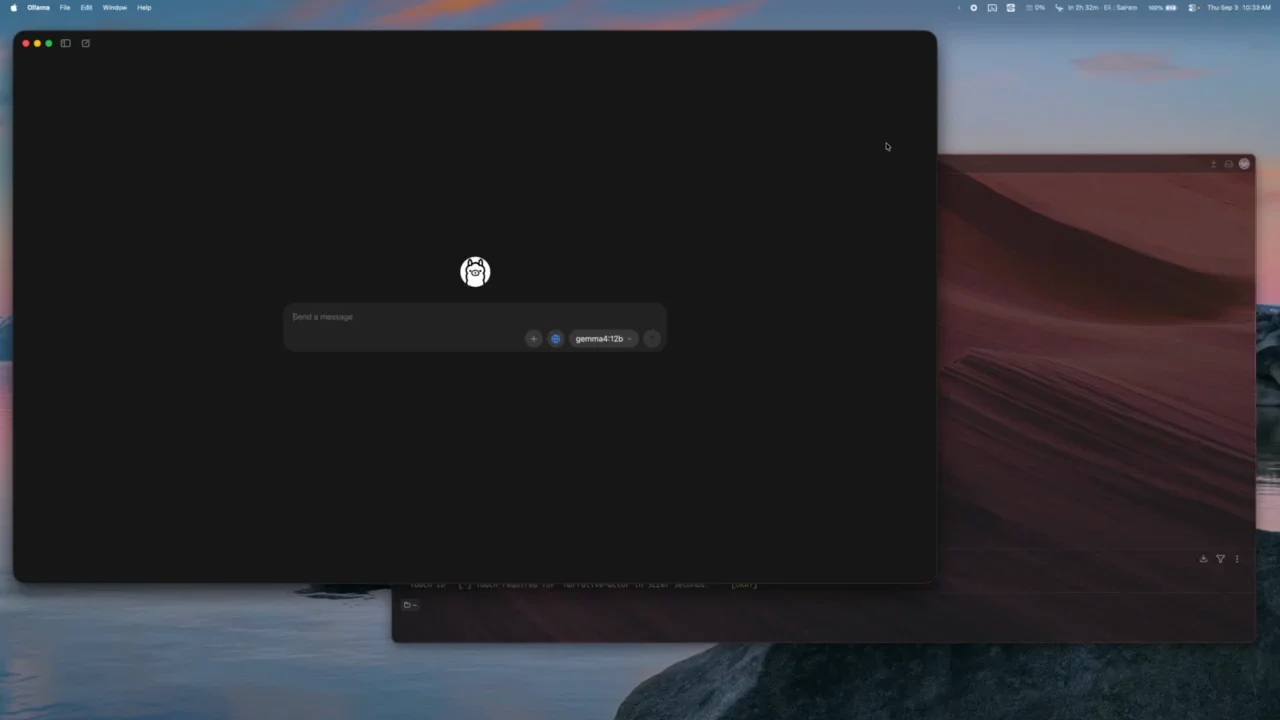
Then the setup, in three commands: install Ollama, run Gemma 4 12B, and call the same model as an API on the laptop.
A small model does not want a conversation; it wants a task. A vague question about a payment problem got a generic answer. A narrow task with the graph’s facts named the change and the rollback.
Together: a frontier model breaks the request into narrow tasks, small models run each one on your hardware, and the graph checks every claim.
I wrote and gave this talk alone, and built the interactive deck it runs on.